




RHEA-FRANCES TETLEY
Historian
The Little Bear Reservoir (Lake Arrowhead) dam project was restarted in 1902 after running out of money during the late 1890s. E.H. “Ted” Kellogg was hired by James Mooney as the new chief planning engineer. His ideas were creative, but execution of his plans did not always go smoothly.
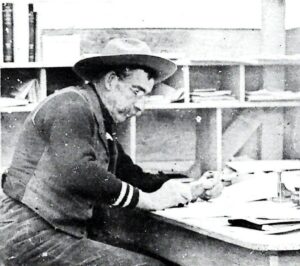
Ted Kellogg, the Little Bear dam project chief engineer.
Kellogg procured the heavy equipment needed for the dam project, some from San Francisco. The two huge steam shovels, a steam hammer, two narrow gage steam locomotives, with 45-dump cars, plus four miles of railroad tracks all had to be hauled up the dirt Waterman Canyon Road switchbacks and transported over to the Little Bear dam site by animal power.
The Hesperia Land and Water Company filed the first of several lawsuits against the Little Bear Reservoir Company, beginning in 1902, complaining about the potential loss of the water that should naturally flow to their area.
Little Bear Valley was finally cleared of trees in 1904 and excavation for the dam began. The decomposed granite rock base was not suitable for a traditional masonry dam, so Kellogg designed a reinforced cement-core earthen dam with a base 60 feet thick and the dam would be 114 feet tall.
The Arrowhead Reservoir Toll Road, up Waterman Canyon, became a free public county road in 1905, doubling wagon traffic. This made hauling the needed cement much more difficult, as the 16-hour trips to the crest now also had to avoid the tourists. So, Kellogg designed an incline cable car system (detailed last week) to transport the cement to the mountain crest.
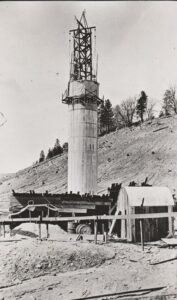
The water outlet tower being constructed.
During the incline’s construction, a rainstorm washed out 150 feet of the pre-graded roadbed. A building error occurred when the rails were just laid through the washout area without any adjustment, resulting in a dip in the final rail alignment. Kellogg designed many repairs to the cable system, but none worked. The incline was a failure and was abandoned.
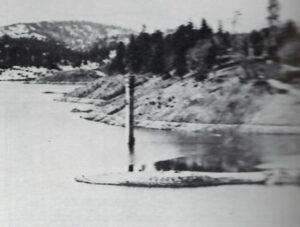
When the water outlet tower was completed in 1908, water was allowed to begin filling Little Bear Valley.
The reservoir project was refinanced up to $6 million, renamed the Arrowhead Reservoir and Power Company as it was decided to also generate electricity, a profitable new commodity, by water power. By the end of 1905, the dam’s cement core wall was 43 feet tall. The tunneling projects to connect the seven proposed lakes were continuing. Tunnel #2 was having cave-in problems, slowing down its extension toward Grass Valley and its connection with Tunnel C. Less than six of the 60 planned miles of tunnels were, as yet, completed. By the end of 1907 the dam was 90 feet tall.
The reinforced 184-foot-tall water outlet tower was built by Arthur S. Bent. It was considered to be the best cement construction at the time and was the tallest free-standing cement structure when completed in 1908. The base is 30 feet square and five feet thick, weighing 700,000 pounds, containing 172 cubic yards of concrete. It was to be the water inlet to Tunnel #1. When the outlet tower was completed, water was at last (after 17 years of planning and building) allowed to begin filling Little Bear Valley. The Arrowhead Company purchased all the downstream land they could, including the Las Flores Ranch, to mute Hesperia’s water rights claims.
As the lake’s water level rose, the cement core-wall of the dam first began to bulge and then leaked! The lake level had to be lowered while Chief Engineer Kellogg tried numerous fixes to this dam failure. Kellogg always had to fix everything after it was built, and then it still didn’t work properly. When none of these retrofitting attempts resolved the leaking problem, Kellogg resigned.
Walter Hy Brown was hired as the new chief engineer. More repairs were made to the dam’s core-wall so, in 1910, the lake level was again permitted to rise. The bulges and cracks in the dam were even worse than before, causing Brown to also quit in frustration.



0 Comments