



By RHEA-FRANCES TETLEY
Historian
In 1905, the county purchased some of the mountains’ lumber roads and opened them to free public wagon use. As the automobile age was beginning, in 1908 “machine owners,” asked to use those mountain roads, but the county said no. Then in April 1909, Dr. John Baylis sponsored a caravan of public officials in seven motorized vehicles, driving up to his Pinecrest Resort. Afterwards, supervisors then set aside some hours each week for motorized vehicles to use the Arrowhead Road.

Jack Heyser in 1910 in his White Steamer. (file photos)
The county purchased the Snowslide Wagon Road route from Fredalba to Fawnskin in the spring of 1910. In July, a large Stoddard-Dayton automobile made news coming up the Arrowhead Road through Waterman Canyon. It negotiated Green Valley’s Snowslide Road, arriving in Fawnskin the same day. Previously, the journey had been a two-day wagon trip requiring an overnight stay in Green Valley. A few weeks later, the Stoddard-Dayton was seen stuck in a river crossing in Big Bear Valley.
Automobile owners liked to challenge each other on difficult roads. The Los Angeles Automobile Club decided to promote a hill climb and came to Pinecrest to organize it. John “Jack” Heyser made a $50 bet he could successfully take his White Steamer Runabout up the Clark Grade, through Big Bear, along the crest and back to San Bernardino.
Heyser assembled a crew, with reporter Opie Warner and Riverside mechanic George Wood. He stripped all unnecessary weight from the vehicle, to compensate for the weight of three people plus the gasoline and tools required for breakdowns in the wilderness.
They left San Bernardino in the Steamer at 8 a.m. on August 27, 1910, headed towards the headwaters of the Santa Ana River. The previous winter had washed out many roads and Clark’s Grade had not been re-graded.

Clark’s Grade to Big Bear.
The perilous trip was described by Warner: “Large boulders struck front and back axles, crank cases, and tore at running boards and upper gear.” He forded water three to five feet deep. It was often necessary to back up a mile or two over boulders and deep swirling fords. Planks were unlashed from the running boards to build causeways over boulders that could not be dislodged. Shovels helped build runways. “Above on the winding, narrow rocky trail, clinging to the mountainside by eyewhiskers… we ran out of water for the steamer. Opie found a spring and brought five gallons of water… the steam gage rose to 600 lbs…. and we finally topped the summit of Clark’s Grade at 11:46 a.m.”
Reaching Big Bear by 2:50 p.m., Heyser stopped at Knight’s Store to buy beef jerky, then continued the trip, scaring the grazing cattle as they sped through the meadow in their loud vehicle. A bull, intending to protect its herd, charged the rear of the car where the gasoline tank was located. Miraculously the crew was able to gain speed to outrun the angry bull.
After passing Fawnskin, the Snowslide Road was almost too narrow for the steamer, but it had only a few logs and stumps to negotiate as the roads they were now traveling had been maintained. They arrived at Tillott’s Waystation in Green Valley by 4:55, continuing past Heap’s Ranch at 6:10 p.m.
Lighting the carbide headlights at 7 p.m., they continued without many problems to Pinecrest, receiving a grand welcome and dinner. There, Heyser used the resort’s magneto crank telephone to tell supporters in San Bernardino that they were returning that evening.
Using his brakes extensively on the 10-to-15 percent grades of the Arrowhead Road, Heyser was able to reach San Bernardino at 9:30 p.m. The trip took 13-and-a-half hours, with actual driving time only 8 hours and 17 minutes.
The point was made that a mechanized vehicle could access the mountains and do what a wagon and team could do, but in much less time.
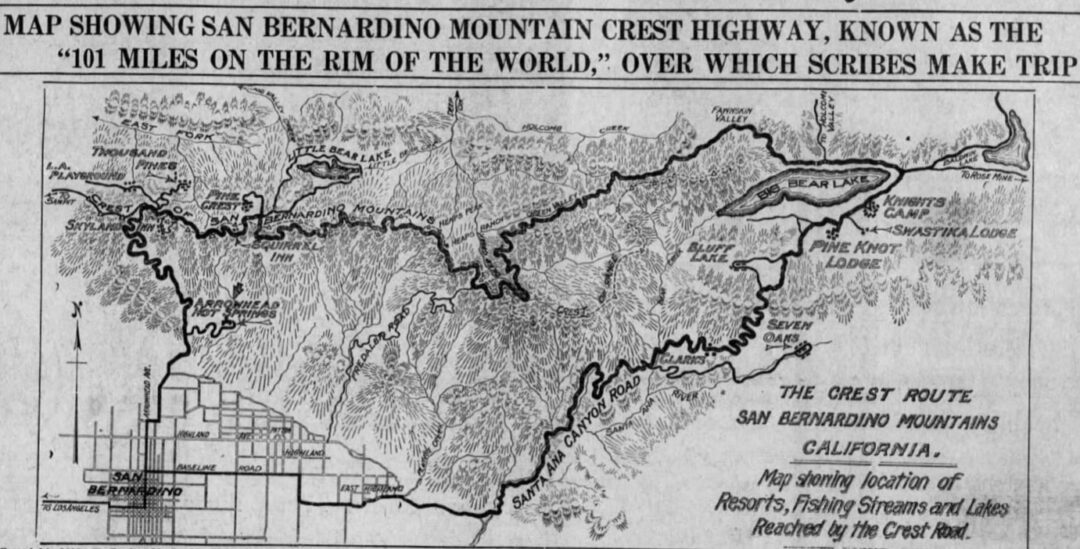
Heyser’s route was the one chosen for Rim of the World Drive when it opened to auto traffic in 1915.



0 Comments