



By RHEA-FRANCES TETLEY
Historian
The dedication of the Rim of the World Drive in the San Bernardino Mountains in 1915 opened mountain access by motorized auto traffic on compacted dirt roads. The eastern end of the road had formerly been the Metcalf and Knight’s Bear Valley Wagon Toll Road to Big Bear. That road went from Hunsaker Flat (now Running Springs), through Green Valley, along the Snowslide Road to Fawnskin on the north shore of Big Bear Lake.
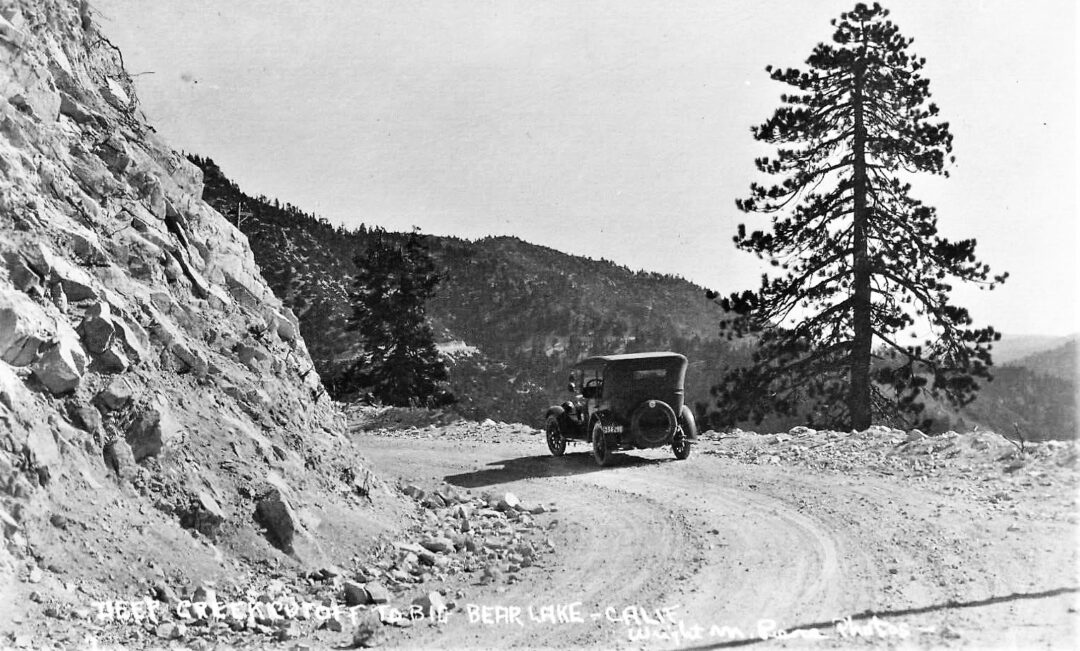
The compacted dirt roadbed of the Deep Creek Cutoff. (Photos from the Tetley photo collection)
This road section almost immediately proved difficult for Green Valley’s George Tillitt to maintain the dirt road for year-round motorized traffic use. The Snowslide Road was often muddy, since it was on the north side of the mountain peaks and received little sunshine to dry out the roadbed, so a better route to Big Bear was needed.
In August of 1922, the San Bernardino County Board of Supervisors awarded a $275,000 contract to the Utah Construction Company to build a new road from Running Springs to Big Bear Lake. This route was called the Deep Creek Cutoff, because Deep Creek ran between Green Valley and Running Springs. This re-routing would save significant Rim of the World Drive travel time for those traveling to Big Bear. And it was on the sunny southside of the mountain peaks, thus avoiding the muddy Snowslide Road between Green Valley and Fawnskin.
The Deep Creek Cutoff would enter the Big Bear Valley area at the 1912 Eastwood Dam, with the road traveling along the western lakeshore to Fawnskin, then joining the old road.
The work began immediately, using the newly developed front-end bulldozers and steam shovels, making it possible to cut the new roadway through the steep 80- to 90-degree slopes. This new road construction presented challenges for the company to even provide places for the workers to eat and sleep, because of its remoteness and lack of previous access to the area.
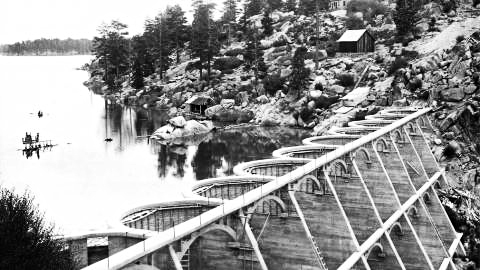
The 1912 Eastwood Dam at Big Bear Lake before the bridge.
In order to speed construction, four steam-powered shovels were operated, working from both ends of the 12-mile route. The dirt-compacted southern-facing Deep Creek Cutoff Road to the dam was completed in the fall of 1923. (This southern slope route was widened to three to four lanes in the 1960s and is now known as the Arctic Circle.) This speed of construction could never occur with today’s road building regulations and safety requirements.
The original project did not include a bridge across the dam. A new concrete bridge road was soon built over the top of the arches of the 12-year-old Eastwood Dam. A new dirt road was cut in 1924-1925, at the far-end of the bridge and along the southeastern shore of the lake to shorten the route to the Big Bear area.
This new route to Big Bear diverted almost all the traffic from traveling to Fawnskin and traffic through Green Valley basically vanished. The residents of Green Valley were concerned their town would disappear. The county didn’t offer any help for this potential economic disaster.
Harry McMullen, aka Green Valley Mac, was a fishing excursion guide, taking fishermen to back-country fishing holes. In 1924, Green Valley Mac decided that Green Valley, to survive, should become a fishing resort. He believed it would be easy to build a dam on the western edge of the valley, across Green Valley Creek to create a lake. He purchased all the available land and then went to the DeWitt-Blair Company, a Los Angeles land development company, selling them on his plan; he then sold them his land. The Dewitt-Blair Company borrowed $85,000 from Union Bank and started building the dam, putting in roads, fresh spring water lines and began to sell the subdivided lots they created.
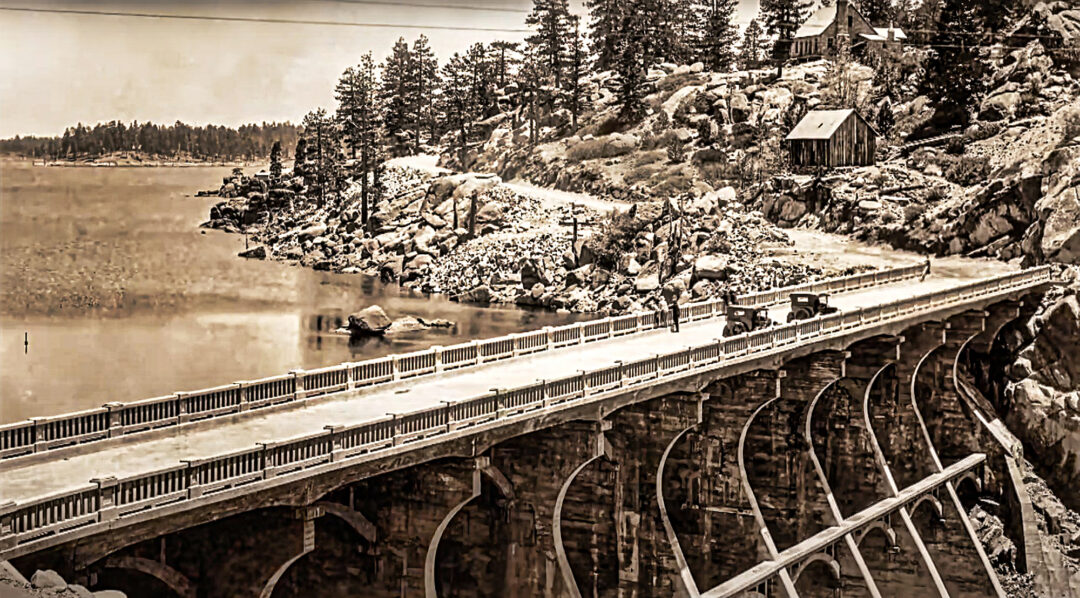
The 1924 bridge over the top of the Eastwood dam, was removed in 2009, when a new wider bridge was built down-stream of the dam.
By 1926, the cement, multiple-arch dam was completed, creating an 11-acre lake at the 7,200-foot elevation. Green Valley Mac promoted the area by writing humorous articles for the “Green Valley News” about how healthful and beautiful it was. The whole community was renamed Green Valley Lake.
The lake attracted visitors to the new Green Valley Lake community. Promotional bus trips from Los Angeles were only $6, with meals included. Many purchased the $150 cabin site lots. Green Valley Lake fishing rights were exclusively for members of the private “Top o’ the World Club,” only for Green Valley Lake property owners, spurring more property sales.
This summer, 2026, the Green Valley Lake community invites everyone to come celebrate the 100th anniversary of the opening of Green Valley Lake; numerous events are planned.



0 Comments