



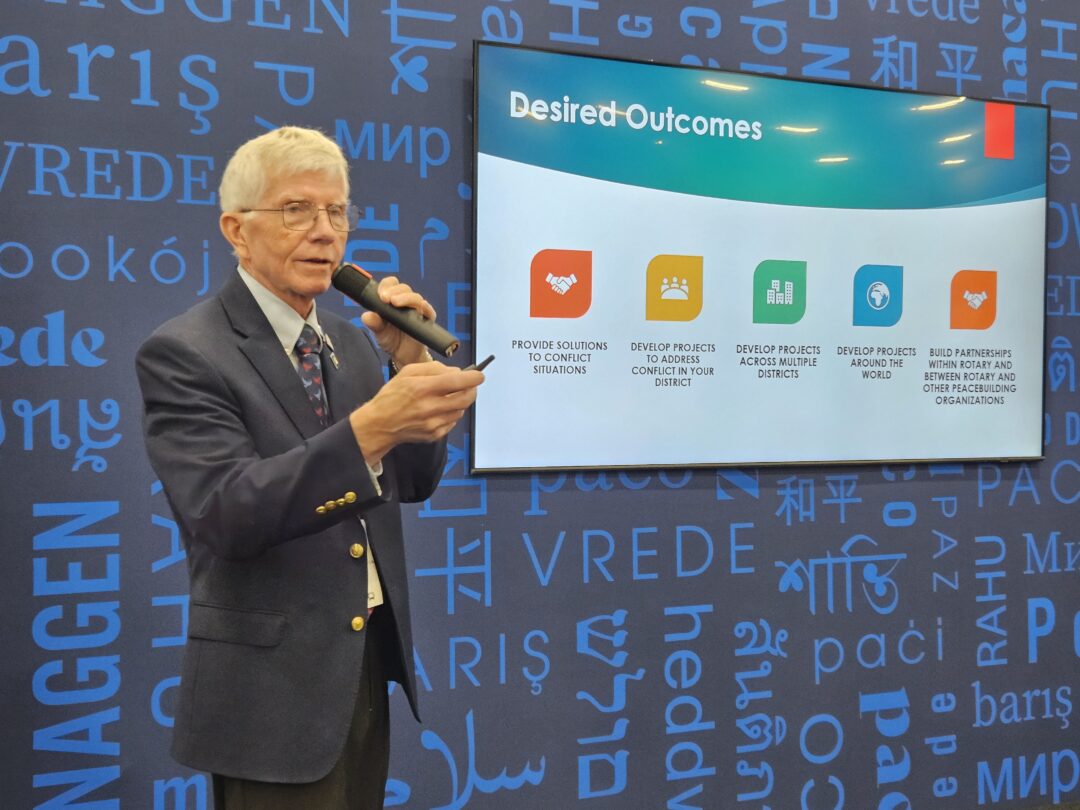
Peace has been a major focus of Rudy Westervelt, the past district governor of Rotary District 5330. In 2016 and 2020 he convened peace conferences in Ontario. He gathered experts from around the world who talked about solutions.
Recently Westervelt led an online district workshop about peacebuilding. During that workshop, one participant commented that “these two conferences caused peacebuilders throughout Rotary to begin to believe that Rotary can build peace globally and within our lifetime.” He called Westervelt a “Rotary peace rock star.”
But what is peace? Repeatedly at Rotary workshops and seminars the point has been made that peace is not the absence of conflict, not the absence of violence. It is the presence of understanding.
Building desks for children who have to learn sitting on a dirt floor is creating peace. Digging a well so a village has clean water – without the women walking for miles to get it – is creating peace.
And Rotary’s goal to eradicate polio, said Westervelt, “has helped us create peace on the planet.” He pointed to Sri Lanka where peace prevailed so children could get immunized.
In Afghanistan and Pakistan there are only a few cases. “Even with Isis,” Westervelt noted, “they don’t want their children to get polio. And, in Gaza, we were able to get in and quickly immunize children.”
Rotary service projects – like digging a well – help families in need. That well meant the girls no longer had to walk for miles and risk getting kidnapped and raped.
When you join Rotary, Westervelt said, you agree to share your time, talent and treasure. Countless members of District 5330 have done just that, going with Vocational Training Teams like the one that went to Thailand to see how they could get potable water to the hospitals.
Through Rotary Friendship Exchanges – the most recent one to India – Rotarians build continuing relationships and friendships. “You break bread together, learn the culture, the foods,” said Westervelt. “We are one humanity on the planet. Rotarian to Rotarian, we can create peace as we expand our family.”
And then there are Rotary Peace Parks, many on the border between countries like Indus on the border between India and Pakistan. “Cross-border districts come together in thoughtful conversation to reduce conflict,” Westervelt said.
At the Rotary international conventions, Rotarians from across the globe come together. “When you are with thousands of Rotarians from around the world,” Westervelt said, “you see the reach we have as Rotarians. It is a way to connect, to develop projects together.”
Calling our youth our strength, our future, Westervelt said the Rotary Youth Exchange is a great way for our young people to learn about other cultures, to make international connections.
He encouraged Rotarians to join a Rotary Action Group. There is a group that promotes peace, ones that address domestic violence, slavery prevention, forced displacement and immigration.
Through Rotary International there are intercountry committees that connect countries like the U.S. and Ukraine, U.S. and Russia, U.S. and Israel, U.S. and India.
“We need to be the peacemakers, take a lead on this more than ever,” Westervelt said.
After his 2016 peace conference, Westervelt founded the E-Club of World Peace which now has more than 80 members in seven countries. They meet weekly online; once a month they meet virtually with a Rotary Club in St. Petersburg.
At the end of the Peacebuilding workshop, Westervelt showed a video, asking the participants to visualize peace. “As we do things in life, we look but do we see; we listen but do we hear; we touch but do we feel?”
“Let’s look out for each other,” Westervelt urged the participants. “Talk to your neighbor – reach out when they need help.
“As Rotarians, the world is open to us. We are making a difference but we can make even more of a difference.”




0 Comments