



By DOUGLAS W. MOTLEY
Senior Writer
Following in the footsteps of other California counties, the San Bernardino County Recorder’s office is seeking out and redacting restrictive covenants that prevent real estate agents, developers or homeowners from buying, selling or renting their property to persons of color, Asians or persons of Jewish descent.
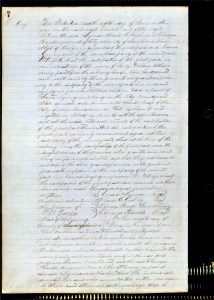
A page from an 1858 deeds book. (SB County Recorder photo)
In an exclusive Feb. 13 interview with the Alpine Mountaineer, the county’s assistant recorder clerk, Genevieve Preston, said what was a common practice in the early 1900s was first banned in 1917 (Buchanan vs. Warley) and again in 1947 (Shelley vs. Kraemer) when the Supreme Court stepped in and ruled that racially restrictive covenants violated the 14th Amendment.
“In 1968,” Preston said, “Congress passed the Fair Housing Act, a policy meant to encourage equal housing opportunities regardless of race, religion or national origin and offers protections for future homeowners and renters and, in its wording, outlawed restrictive covenants.”
Furthermore, according to a Feb. 6 article in The Los Angeles Times, Historian Laura Redford, a visiting professor from Brigham Young University, found that by 1939, 47 percent of Los Angeles County residential neighborhoods had restrictive covenants that forbade certain racial groups from those communities. If you were to buy a house today that was built prior to 1968, you’d probably still see the language in your land records.
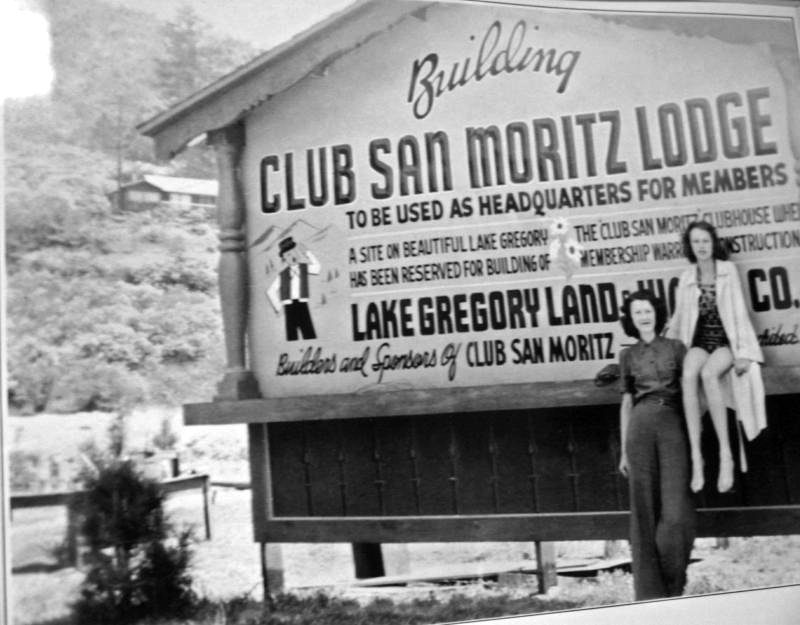
Such covenants were also enforced by Crestline’s exclusive Club San Moritz, which was incorporated in 1939. According to local historian Rhea-Frances Tetley, the club would not accept membership nor sell property to certain racial groups and those who had changed their surname to disguise their historical ethnicity, because it was a private club. This, Tetley said, was also a common practice in the Lake Arrowhead area during the 1920s through the 50s, when maids, butlers, chauffeurs and other household workers were required to enter the residence from the “servant’s entrance.”
Such was also the case in the Running Springs communities in the 1960s when a man who was of Native American descent didn’t pays his dues and was expelled from the club. He then filed a lawsuit, alleging racial discrimination. It’s not clear whether he won or lost the lawsuit; however, the end result was that the other private clubs on the mountain either opened their membership or dissolved.
In September 2021, California Governor Gavin Newsom signed Assembly Bill 1466, which went into effect on July 1, 2022, and banned racially restrictive covenants, once and for all.
Assistant San Bernardino County Recorder Joani Finwall was asked whether her department had to hire extra employees to scan property deeds and other county records for racially restrictive language and how enforcement of AB1466 would affect property taxes. “Everything is digitalized,” she said, “and we have a company, US Imaging, that uses an optical character records recognition computer to do the redacting. We keep the records in a digital library.”
“The San Bernardino County Recorder’s Office,” Preston said “has been working diligently on reviewing and preparing our documents for compliance with AB1466. Thus far, documents from 1958 to 1968 containing restrictive covenants have been reviewed and identified for redaction. There are over three million documents from this time period relating to property in the Recorder’s records.
“The Recorder’s office has been working with US Imaging, who currently creates microfilm and digitizes records needed for such projects,” she continued. “US Imaging narrowed down the list through use of optical character recognition and review to cover 17,000 documents for the San Bernardino County staff to read. Of these, over 1,000 were presented to county counsel for review and redaction.”
Preston added that Recorder’s records are available in-house at the Hall of Records for review from 1958 to present and the index can be viewed online through a link on their webpage, https://arc.sbcounty.gov/official-records.



0 Comments