



By Elise Gray
Special to the Alpine Mountaineer
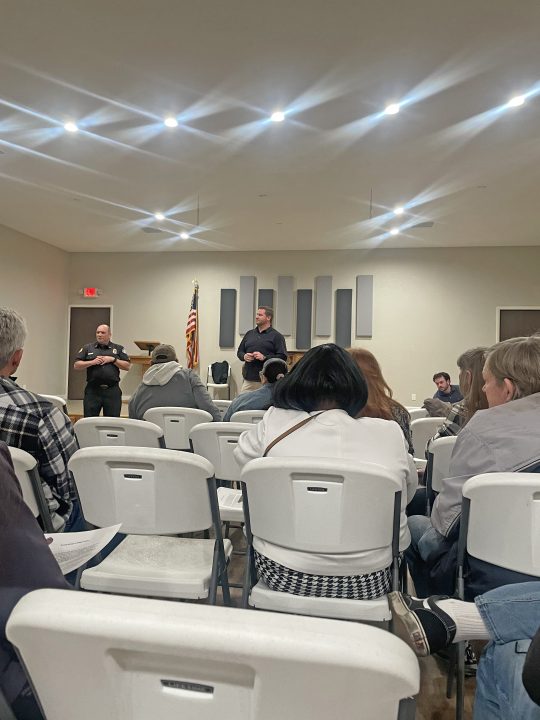
On Feb. 20, residents gathered at the Robert Hootman Community Center to discuss a topic plaguing many Californians as of late: rising insurance premiums. Mountain communities continue to face an alarming surge in insurance costs, with residents facing non-renewals while others see rising premiums. Those who manage to secure policies with ever-changing landscapes must navigate strict new requirements and mounting payments.
A.J. Darrah, managing director of RockRose Risk, has helped secure alternative coverage options for communities throughout California, including in high-risk areas like Napa and Sonoma. His recent visit to Running Springs left him in awe over the community’s mitigation efforts.
“I’ve never seen a community so prepared. It’s mind-blowing,” he said. And yet, for some homeowners, these extreme hikes in rates have become an unavoidable reality. One resident reported that the only available insurance policy for their home came with a $50,000 annual premium – an unsustainable $4,100 per month, despite having a mortgage of less than $50,000.
“They’re looking at everything from 6,000 feet up and painting entire areas red,” Darrah explained. “But if a county has done fuel treatments, that should change the model.”
Potential short-term solutions
Darrah proposed a captive insurance program through RockRose Risk, a form of self-insurance where premiums are pooled annually to be retained or distributed, with rewards for mitigation efforts. Captive insurance companies are typically owned and controlled by their insured, with insured parties incurring all the risk in exchange for potential rewards.
This model can yield several benefits, such as the potential for reduced costs and more access to personal data. With a traditional insured plan, costs remain fixed regardless of low-claim history. Captives promise a drop if one maintains a low-claim history.
RockRose Risk is exploring the possibility of launching a pilot program in Running Springs, starting with 200 homes in the area. “Captives are how insurance is supposed to work,” Darrah explained.
However, captives are not without their challenges, including high start-up costs and a hefty personal investment on behalf of the insured to gain capital. If one experiences a range of claims, that capital could be lost. Given the current landscape, many long-time mountain residents may be obliged to take on such risks as the alternatives are few and far between.
However, alternatives were presented to residents, such as the Firewise USA® program, which could also serve as a viable, short-term solution to rising insurance costs. “I’m part of the Firewise program in Arrowbear. We have a lot of flammables around – gas cans, old cans and propane. I’m working on a way to reduce hazardous waste,” said one resident.
According to their website, Firewise provides actionable steps to reduce the risk of destruction from wildfire. Residents in Firewise-certified areas were instructed to contact Dixi Willemse, office secretary at Running Springs Fire Department, for a certificate. If they’re not eligible, there are steps available to help community members obtain a certificate, which could ultimately lead to insurance discounts when presented.
Without meaningful policy reform and innovative insurance solutions, homeowners in high-risk areas continue to ride the waves of uncertainty with limited options and the presumable threat of losing coverage.
All the while, one question remains: What can be done?





0 Comments