



By RHEA-FRANCES TETLEY
Historian
Edward Barber Daley played a major role in both mountain history and in the early road development in the entire San Bernardino Valley. Born on March 31, 1825, in Skaneateles, N.Y., he moved near Mentor, Ohio, at age 6 and also lived in Illinois, Mississippi and Missouri.
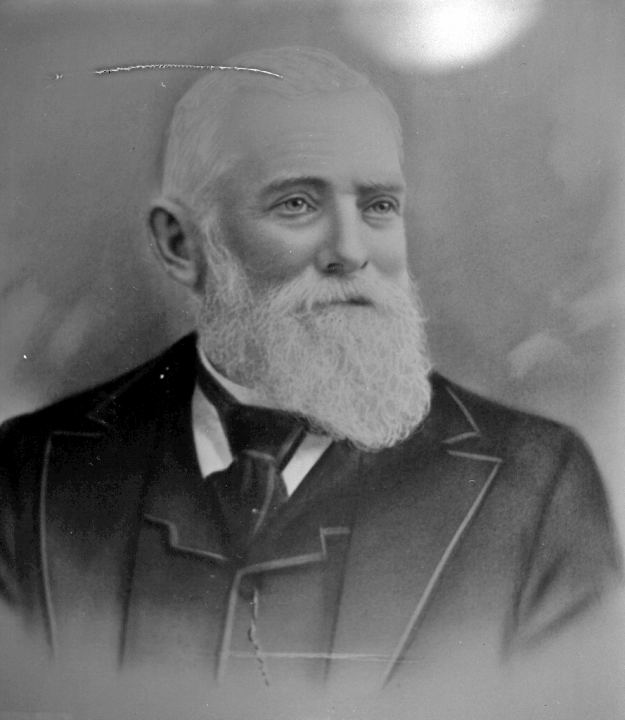
Edward B. Daley
He married Nancy Hunt in 1846, in Council Bluffs, Iowa; then they joined Captain Jefferson Hunt, his father-in-law, as part of the 1851 wagon train of Mormon settlers traveling to colonize San Bernardino. The mortgage on Lugo’s 80,000-acre San Bernardino Ranchero that the Mormon Colony had purchased had a 3-percent monthly interest rate, motivating the colony to pay it off quickly.
The two most profitable business ventures for making quick money were providing the swiftly growing Los Angeles area with lumber – which was convenient since there was a forest on the mountaintop – and flour, since everyone needed to eat. The Mormon Lumber Road was created up a steep 12-mile route through Twin Creek Canyon (Waterman Canyon) in 1852. Every able-bodied man, especially Daley who was an engineer, assisted during those two-and-a-half weeks of building the road.
Daley also knew how to farm, helping to plant a 1,300-acre wheat field, irrigated by a colony-dug ditch from West Twin Creek, north of the colony. The wheat was ground into flour and, along with lumber, was profitably sold in Los Angeles.
Daley became one of the most successful farmers and opened the area’s first restaurant, “The Daley Inn,” at Third and E streets, used by travelers visiting the new San Bernardino County, just formed by David Seely’s committee in 1853. Daley was becoming a respected leader. His home was on North C Street (Arrowhead Avenue).
In 1857, when Mormon Church President Brigham Young recalled his faithful back to Salt Lake with “all haste to prepare for the defense of the city against a threat from the United States Army being sent to Utah by President James Buchanan,” the Daley family – Edward, Nancy and their 11 children, Laomi, Celia, Edward Jr., Charles Jefferson, John, Grace, Annetta, Frank, Lou, May and Kate – decided to stay in San Bernardino and help it thrive.
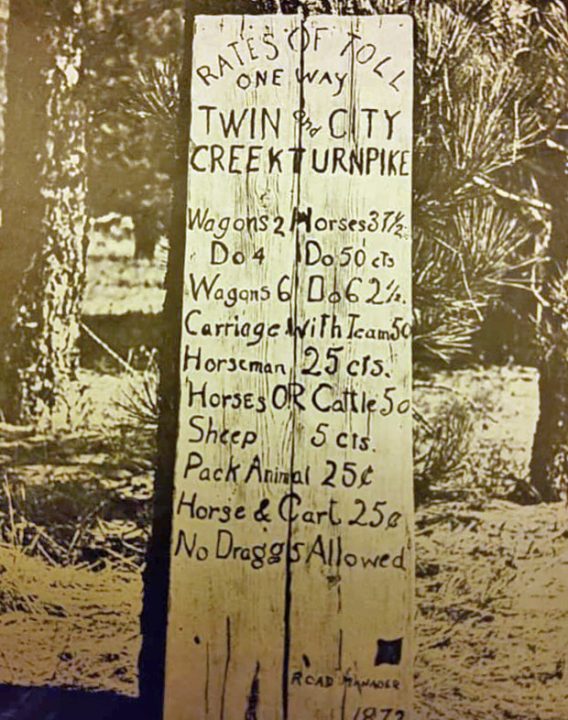
Toll rate sign for the Twin and City Creek Turnpike.
The Mormon Road was severely damaged by the 1862 Noachian Deluge and again in 1867. Since logging was such a profitable business, Daley began with family and investors the Twin and City Creek Turnpike surveying company to construct another logging road into the mountains. They used the canyon north of Del Rosa, going up the steep slopes between Strawberry Creek and the west fork of City Creek, cresting the mountain just east of Strawberry Peak, then descending to Little Bear Valley (L.B.V.) through Daley Canyon, alongside the headwaters of the future Lake Arrowhead. The Daley Road offered convenience to the Talmadge, LaPraix and other L.B.V. sawmills, enabling them to expedite the transportation of lumber down the mountain.
The Twin and City Creek Turnpike opened on May 14, 1870, and, despite its many sharp curves, it enabled teamsters to travel from San Bernardino to L.B.V. in only six to seven hours, on the steep 12-foot wide, dirt roadway. The tolls were: sheep or goats, 2 cents each; horse, mule or cattle, 6 cents each; horse with rider, 12½ cents; buggy with single horse, 25 cents; buggy/wagon with two animals, 37½ cents; additional animals, 6 cents each.
Edward Daley was elected 3rd District County Supervisor, serving from Jan. 5, 1880, to Jan. 8, 1883. Daley (71) died at home on Jan. 25, 1896. Not surprisingly, Edward’s grandson, J.S. Bright Jr., while the San Bernardino County surveyor, was the engineer creating the Rim of the World Drive for automobiles along the crest of the San Bernardino Mountains, from 1911 to 1915.
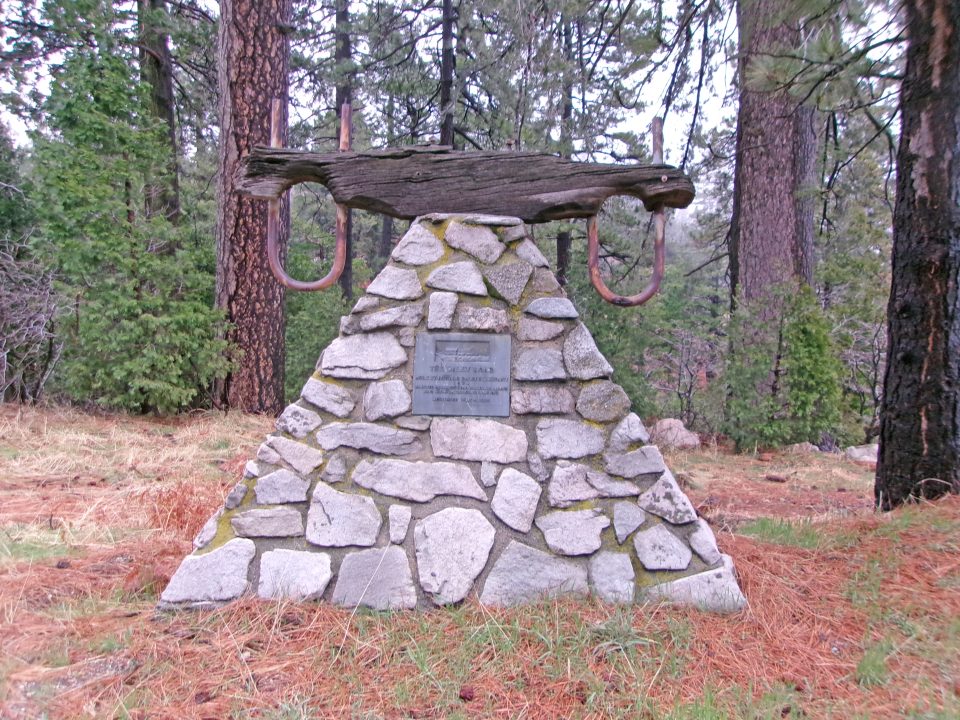
Plaque on the Daley Canyon Road monument.



0 Comments