



By RHEA-FRANCES TETLEY
Historian
The lumbering industry in the Little Bear Valley area was moving forward full speed in the 1880s and the steam-powered lumber mills were cutting the larger trees that the earlier mills couldn’t handle. The lumbermen usually left at least one large healthy tree in each area so it could naturally reseed and left the smaller trees to grow, as not enough lumber would be produced and wasn’t worth their effort.
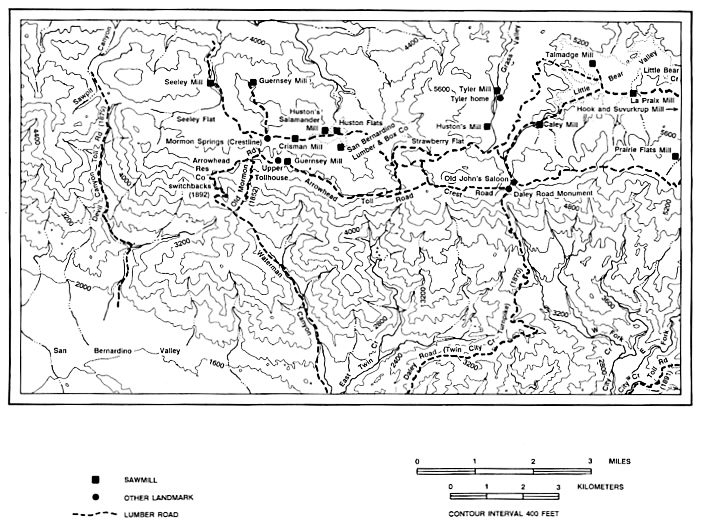
(Photos from The San Bernardinos by John W. Robinson)
The logging continued until two major changes occurred around 1891. First was the establishment of the National Forest Preserve, which limited logging on public lands, essentially putting many of the sawmills out of business. Cutting continued on privately owned lands, so the Danaher and Brookings sawmills continued to operate.
At this time, agriculture in the valley areas was becoming more important, since people were moving to California, and the growing communities demanded fresh produce.
Dr. Benjamin Barton of Redlands had incorporated the Big Bear Reservoir and Irrigation Company in 1884 and constructed a $75,000 dam, creating a steady year-round flow of water for Redlands agriculture, plus creating a lake in the mountains that began to attract visitors.
Lake Arrowhead is a manmade lake, intended to be a water reservoir for an irrigation project envisioned to provide agricultural water to the San Bernardino Valley, like the Big Bear Dam had done for Redlands. For San Bernardino City Engineer Adolph H. Koebig, a lake for San Bernardino was a natural concept since it was based on the 1887 Wright Irrigation Water Act, signed into law by San Bernardino’s own resident, California Governor Robert Waterman.
Koebig, a civil engineer, and newspaper editor L H. Holt, who was also an expert on irrigation, made many mapping trips into the mountains, evaluating the potential for getting additional water for the fertile San Bernardino Valley to expand its agriculture industry.
Unable to find any local funding sources, Robinson Jones suggested that Koebig and Holt should travel to Cincinnati, Ohio, to meet with investors he knew. In Ohio, they met with Jones’ stepfather, Colonel Adolph Wood, whom they convinced that San Bernardino both needed and wanted a water project.
They invited Wood and his business associates, Benjamin Erhman and Colonel Lantham Anderson, to come to California disguised as a vacation for Wood to see Jones. While in California, they “casually” visited the mountains, where they instantly saw the real potential for investment and profits.
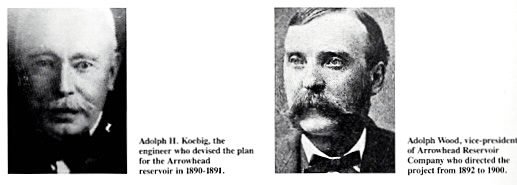 The men established the Arrowhead Reservoir Company (A.R.C.) in December 1890, capitalized at $1 million. The A.R.C. purchased the water rights in May 1891 and began purchasing individual sawmills from the mountain lumbermen that June.
The first thing the Arrowhead Reservoir Company needed to do was build a road to bring materials up the mountain for their project. They wanted an exclusive road and chose Waterman Canyon, originally known as “Smith Canyon” (named by the Mormons after Joesph Smith LDS Founder), and later known as Twin Creek Canyon. The Mormon Road had been washed out by the Noachian Deluge and rebuilt as the Pine Mountain Turnpike in the latter 1860s, which again flooded and then was abandoned, after the much better Daley Toll Road and Devils Canyon Toll Road took over the lumber transportation responsibilities.
When Waterman bought the area, he hadn’t permitted any road to be built through the canyon because he didn’t want his delicious, spring water to be contaminated by teams pulling wagons through the area. Governor Waterman, who didn’t run for re-election, died in 1891 after his one term as governor. The A.R.C. successfully negotiated with the family to construct a road through the newly named Waterman Canyon to access Little Bear Valley. Thus changed the destiny of Little Bear Valley.



0 Comments