



By DOUGLAS W. MOTLEY
Senior Writer
Last week’s series of rain and snowstorms, powered by an atmospheric river that originated in the Hawaiian Islands, swirled northeastward toward Northern California. There its 100-mile-per-hour bomb cyclone gusts wreaked havoc on the San Francisco area. Then it dropped up to 10 feet of snow in the Sierra Nevada range before heading toward Southern California.
Once it landed in Southern Calidoernia, it brought severe flooding and mudslides to the Los Angeles and Long Beach areas, forcing the evacuation of hundreds of hillside homes due to mudslides, as well as dozens of swift water rescues of motorists who had abandoned their vehicles.
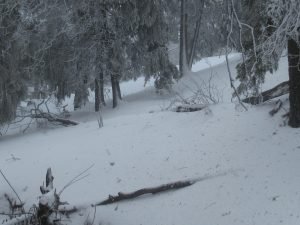
A fallen tree lies partially buried in snow near a residence on Skyland Drive.
While an atmospheric river is a storm that has latched onto subtropical moisture all the way from the Hawaiian Islands and delivers it to the West Coast, so-called bomb cyclones refer to the rapid intensification of a storm within a 24-hour period, a process that’s known as bombogenesis, in which the storm’s pressure falls 24 millibars in 24 hours. It’s caused by an area of low pressure where air at the surface begins to rise in the center of the storm. If the air spirals upward to the top of the storm faster than it can be replaced at the bottom of the storm, the pressure will fall rapidly; it will be categorized as a bomb cyclone, in which wind speeds can reach 75 miles per hour, causing flying debris, uprooted trees and structural damages to fences, utility poles and roofs, such as that seen in last week’s series of post-holiday storms.
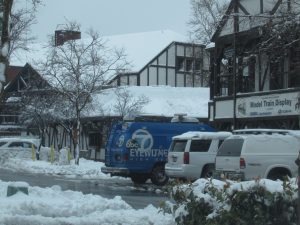
Channel 7’s Eyewitness News team reported from Lake Arrowhead village last Wednesday.
In the mountaintop communities – some of which received upwards of 10 inches of rain and two or more feet of snow – even with the 70-mile-per-hour wind gusts, the damages were less severe than in the Ventura and Los Angeles County coastal areas. San Bernardino County spokesman David Wert told the Alpine Mountaineer on Friday, Feb. 9 that, despite the intensity of long periods of hard rain and snow accumulation, most of the damages were confined to downed powerlines and tree branches, as well as some power outages. Several residents and business owners also reported minor flooding of their homes and businesses.
Fortunately, this year’s atmospheric river storms have resulted in less damage to the mountain communities than last year’s, which brought seven to 10 feet of snow to the Crestline, Lake Arrowhead and Running Springs areas and damage and destruction to several hundred homes and businesses, including the roof collapse of Goodwin’s Market.
——————————-





0 Comments